What is card sorting?
Card sorting asks people to group a list of items into piles that make sense to them, and then name those piles. It shows you the structure customers already carry in their heads rather than the one your team assumed. In consumer research it is used on concepts, needs, benefits and features, not just website menus.
What is the difference between open, closed and hybrid card sorting?
In an open sort, participants create and name their own groups, which is how you discover a structure. In a closed sort you supply the categories and they file the cards into them, which is how you validate a structure you already have. A hybrid sort gives them your categories and lets them add their own. SortedResearch runs all three.
How many participants do I need for a card sort?
About 15 participants gives a result that correlates around 0.90 with what a much larger group would tell you, according to Nielsen Norman Group guidance. At 20 to 30 that rises to roughly 0.93 to 0.98 and then flattens out (Tullis and Wood, 2004). So 15 is a defensible floor for a directional read and 30 is the practical ceiling for most studies.
Can participants do a card sort on a phone?
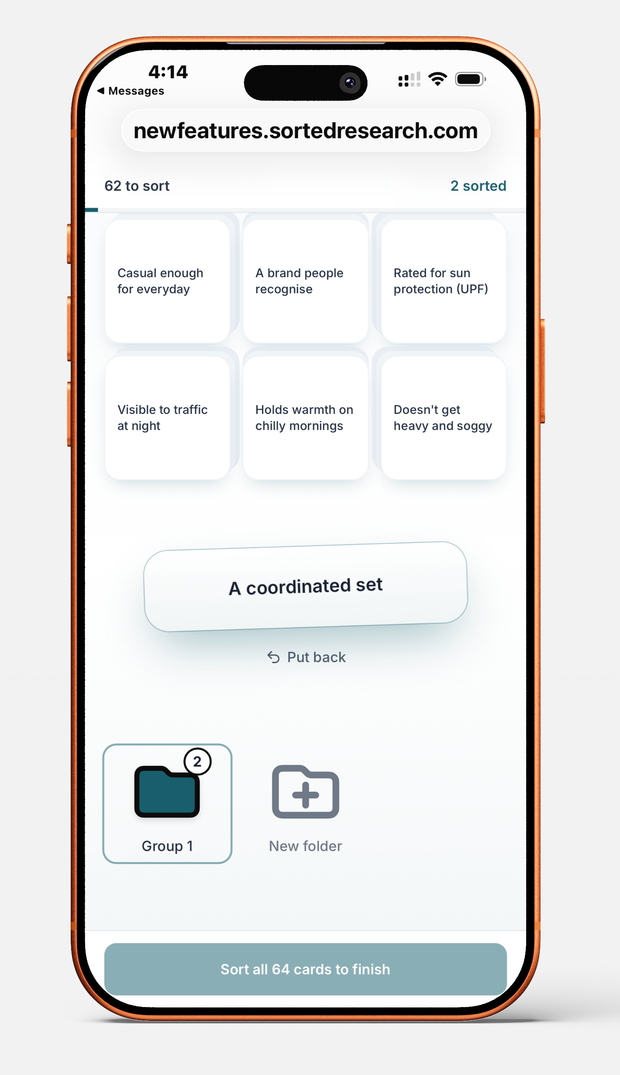
Yes. The sorting flow is built for a phone screen first, which is where most panel respondents are. That is a large part of why completion rates hold up on long decks.
How big can a card deck be?
Decks of 60 cards stay readable for participants and stay legible in the analysis. The similarity matrix, the dendrogram and the 3D cluster view are all built to hold their shape at that size, which is where many tools start to blur.
What happens after the sort?
You get a similarity matrix, a dendrogram and 3D clusters, and Graham suggests names for the groups people created. From there one click carries those groups into a pairwise, Best-Worst or Findability study, so you go straight from structure to priority without retyping anything.