What is a pairwise comparison survey?
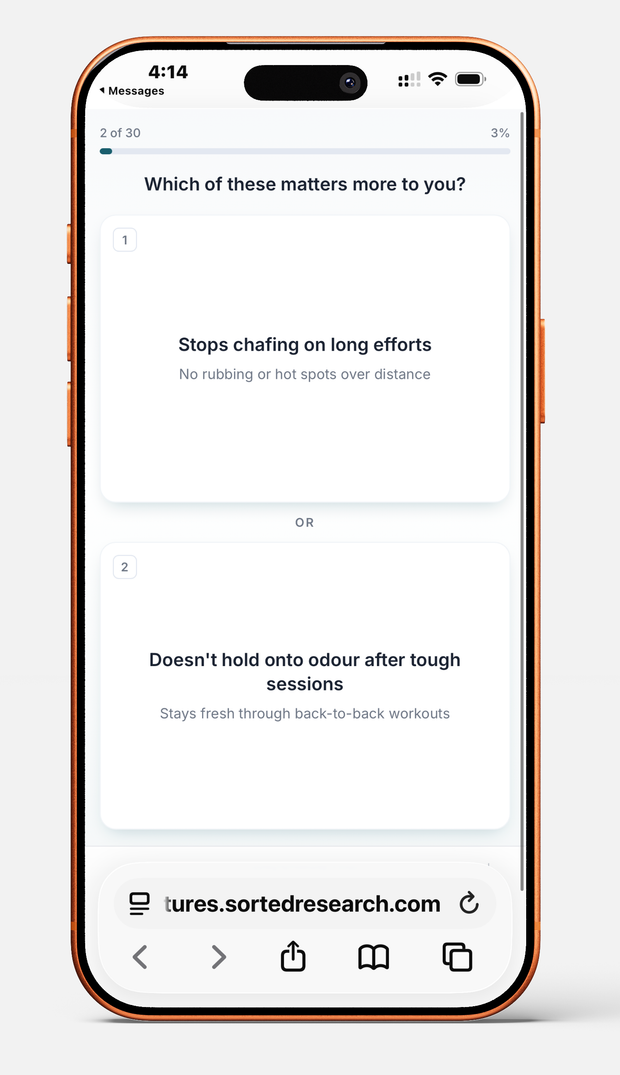
It shows participants two items at a time and asks which matters more. A run of quick, easy choices adds up to a reliable ranking of the whole list, without asking anyone to rate twenty things on a scale they will not use consistently.
What is an opportunity matrix?
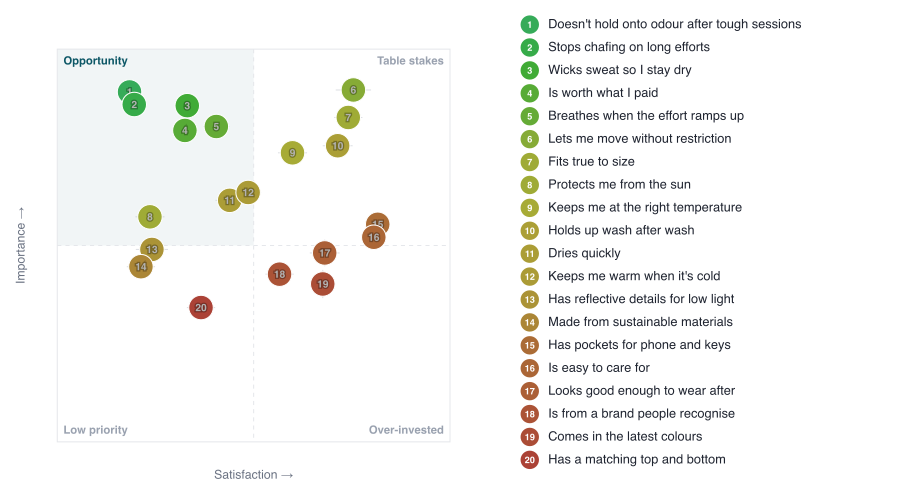
A plot of every need by how important it is against how well it is met today. The needs that are important and poorly served are your unmet needs, and that quadrant is where the opportunity sits.
Should I use pairwise or Best-Worst (MaxDiff)?
Use pairwise when you want importance and satisfaction together, so you can find gaps rather than just an order. Use Best-Worst when the list is long and you want one clean, forced ranking of what matters most.
How many participants do I need?
Around 30 completed responses per dimension for a directional read, and 100 or more per dimension before you bet a roadmap on it. Measured against our own scoring, pairwise needs about twice what a card sort does, because each person sees each item only three times. At 30 the ranking is solid, but roughly one need in four still lands in the wrong quadrant of the opportunity matrix, and that is what you decide from.
Can I build a pairwise study from a card sort?
Yes, in one click. Graham carries the sort's group names and descriptions across as the items to rank, so nothing is retyped and nothing is lost in translation.
How long does it take a participant?
Each choice is two options and one tap, and the flow is built for the phone in their hand. That is why people finish it, which is the part that decides whether your data is any good.